
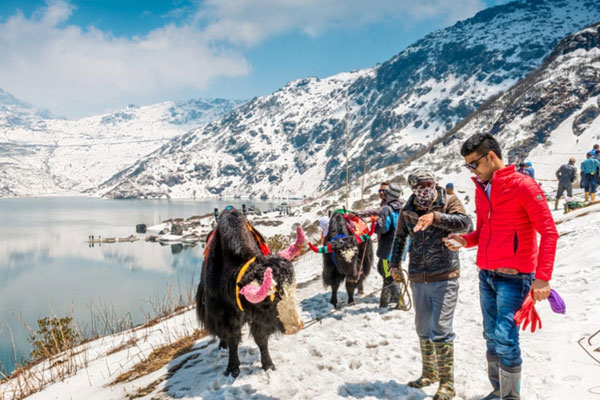
Sikkim is a state in Northeastern India. It borders the Tibet Autonomous Region of China in the north and northeast, Bhutan in the east, Koshi Province of Nepal in the west and West Bengal in the south. It is also close to the Siliguri Corridor which borders Bangladesh.
Sikkim is notable for its biodiversity, including alpine and subtropical climates, as well as being a host to Kangchenjunga, the highest peak in India and third highest on earth. Almost 35% of the state is covered by Khangchendzonga National Park.
The state of Sikkim is characterized by mountainous terrain, as it is situated in Himalayan Mountain. Almost the entire state is hilly. Kangchenjunga, the world’s third-highest peak, is the state’s highest point. Due to the rocky and precipitous slopes, land is not suitable for agriculture.
The state has 28 mountain peaks, more than 80 glaciers, 227 high-altitude lakes including the Tsongmo, Gurudongmar and Khecheopairi lakes, five major hot springs and more than 100 rivers and streams. Also, eight mountain passes connect the state to Tibet, Bhutan and Nepal.
Sikkim’s hot springs are renowned for their medicinal and therapeutic value. Among the state’s most notable hot springs are those at Phurchachu, Yumthang , Borang, Ralang, Taram-chu and Yumey Samdong. The springs, which have a high sulphur content, are
located near river banks; some are known to emit hydrogen. The average temperature of the
water in these hot springs is 50 °C (122 °F).
The state has five seasons: winter, summer, spring, autumn, and monsoon season. Sikkim’s climate ranges from sub-tropical in the south to tundra in the north. Most of the inhabited regions of Sikkim experience a temperate climate, with temperatures seldom exceeding 28 °C (82 °F) in summer. The average annual temperature for most of Sikkim is around 18 °C (64 °F).
Sikkim is one of the few states in India to receive regular snowfall. The snow line ranges from 6,100 metres (20,000 ft) in the south of the state to 4,900 metres (16,100 ft) in the north. The tundra-type region in the north is snowbound for four months every year, and the temperature drops below 0 °C (32 °F) almost every night. In north-western Sikkim, the peaks are frozen year-round;[67] because of the high altitude, temperatures in the mountains can drop to as low as −40 °C (−40 °F) in winter.
During the monsoon, heavy rains increase the risk of landslides. The record for the longest period of continuous rain in Sikkim is 11 days. Fog affects many parts of the state during winter and the monsoons, making transportation perilous.
The forested regions of the state exhibit a diverse range of fauna and flora. Owing to its altitudinal gradation, the state has a wide variety of plants, from tropical species to temperate, alpine and tundra ones, and is perhaps one of the few regions to exhibit such a diversity within such a small area. Nearly 81 per cent of the area of Sikkim comes under the administration of its forest department.
Sikkim is home to around 5,000 species of flowering plants, 515 rare orchids, 60 primula species, 36 rhododendron species, 11 oak varieties, 23 bamboo varieties, 16 conifer species, 362 types of ferns and ferns allies, 8 tree ferns, and over 900 medicinal plants. A relative of the Poinsettia, locally known as “Christmas Flower”, can be found in abundance in the mountainous state. The Noble Dendrobium is the official flower of Sikkim, while the rhododendron is the state tree.
Orchids, figs, laurel, bananas, sal trees and bamboo grow in the Himalayan subtropical broadleaf forests of the lower altitudes of Sikkim. The fauna of Sikkim include the snow leopard, musk deer, Himalayan tahr, red panda, Himalayan marmot, Himalayan serow, Himalayan goral, muntjac, common langur, Asian black bear, clouded leopard, marbled cat, leopard cat, dhole, Tibetan wolf, hog badger, binturong, and Himalayan jungle cat. Among the animals more commonly found in the alpine zone are yaks, mainly reared for their milk, meat, and as a beast of burden.
The avifauna of Sikkim include the impeyan pheasant, crimson horned pheasant, snow partridge, Tibetan snowcock, bearded vulture and griffon vulture, as well as golden eagles, quails, plovers, woodcocks, sandpipers, pigeons, Old World flycatchers, babblers and robins. Sikkim has more than 550 species of birds, some of which have been declared endangered.
Sikkim also has a rich diversity of arthropods, many of which remain unstudied. Some of the most understudied species are Sikkimese arthropods, specifically butterflies. Of the approximately 1,438 butterfly species found in the Indian subcontinent, 695 have been recorded in Sikkim. These include the endangered Kaiser-i-hind, the Yellow Gorgon and the Bhutan Glory.